
National Fitness Awareness Day: Powered by You!
Trying to “get fit” can feel daunting. Which workout plan should you follow? Where do you even start? How much will it cost? And, you might not be totally sure why you want to “get fit” in the first place.
Seeing as the theme this year is “Powered by You!” we wanted to simplify things and help you reframe your mindset around exercise in perimenopause and menopause. This post encourages small sustainable steps towards long-term health and fitness goals, and hopefully will inspire you to get moving in a way that feels right for you.
Menopause vs. perimenopause: a quick recap
Menopause is a moment in time: the point marked 12 months after your last period, usually happening somewhere between the ages of 40 and 65. It can happen naturally, surgically or medically.
Perimenopause is the stretch of time before your periods stop. It’s marked by shifting hormones as the ovaries slow down which can bring on a whole range of symptoms: hot flushes, headaches, mood swings, fatigue, vaginal dryness, low sex drive, anxiety and heart palpitations.
These symptoms range from mild to severe, and they can interfere with quality of life. The main conventional treatment is HRT (hormone replacement therapy), which is generally considered safe and effective but can carry an increased risk of strokes and breast cancer. For many women, HRT is a genuinely great option, and completely necessary in some cases; there’s nothing wrong with choosing it.
Exercise, by comparison, comes with no such side effects, and it has real potential as a natural way to ease perimenopause symptoms alongside, or instead of, HRT.
Physical exercise and dietary changes are increasingly being looked at as a supplement to HRT. For some women, they are even an alternative. Physiologically, exercise helps regulate the endocrine system (the network of glands and organs that produce and release hormones), it also improves cardiovascular health, and helps to reduce cholesterol.
But the hardest part is knowing how and where to start…
1. Find your why
Why do you really care about fitness? Is it the symptoms? Confidence? Mood? Staying healthy and injury-free for the long run? Whatever it is, it needs to be personal and genuinely meaningful to you.
If your first thought is aesthetics, dig a little deeper: is it really about how you look? Or is it about the confidence that comes with that, or wanting to feel able to go dancing the way you did when you were younger? It’s rarely just about appearance. You want a reason strong enough to pull you through the days when motivation is nowhere to be found.
2. Find something you actually enjoy
The gym isn’t for everyone, and that’s fine. There’s a whole world of ways to move: that big hike you’ve always wanted to tick off, camping, wild swimming, rock climbing, surfing, dancing, chasing your kids around the garden, running, tennis, paddle sports. The options are endless.
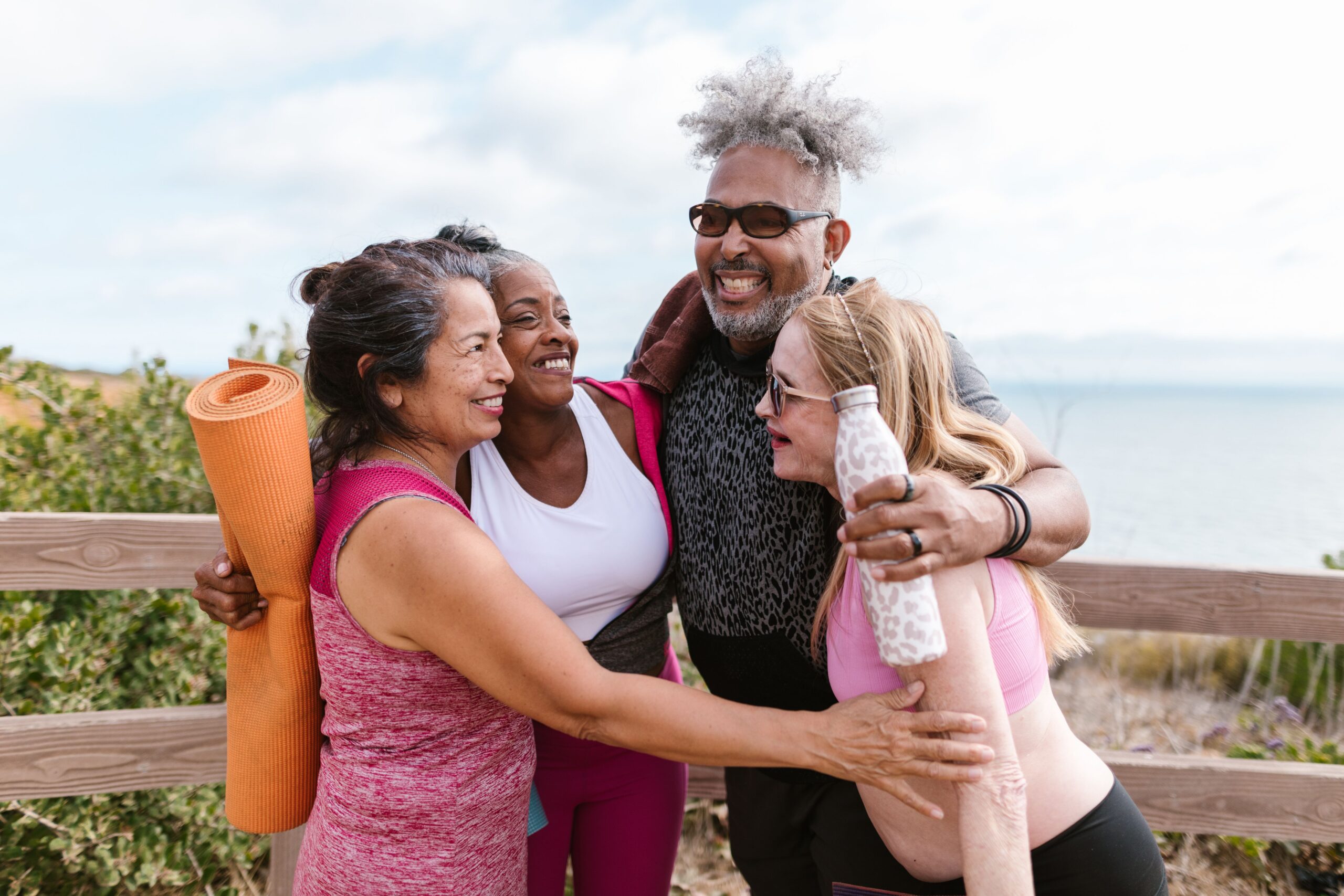
Once you find something you enjoy, you might notice you’re doing it with friends, or using it as quality time with loved ones, a way to switch off from work, or a way to chip away at your bucket list. That’s what keeps you coming back, often without even realising you’re “staying fit.”
Resistance training and weight lifting aren’t usually anyone’s favourite activity going in, but plenty of people grow to love how it makes them feel: strong enough to carry all the shopping in one trip, or a way to improve at a sport you’ve realised you love. It’s also very important for preventing injury.
3. Plan the exercise, and plan to fail
Put it in the plan that you will miss days, because you will. Everyone does, and there’s nothing wrong with that. Planning for it means that when it happens, you won’t spiral and give up altogether. And if you find that the activity you pictured yourself loving (the hiking, the dancing) just isn’t for you, that’s fine too. Quit it and try something else. There’s no point forcing yourself through something you don’t enjoy.
4. Track how you feel, not how hard you worked
If you have the time, jot down how you feel after a session. Give yourself a moment to notice the benefit and soak it in. Don’t track intensity: it’s the feeling of pride and achievement that sticks with you, not the numbers. “Celebrate the consistency, not the intensity”(Micky Lal).
5. Start small
A little bit every day goes a long way. It won’t hurt anyone to start small, and if you genuinely want to reach your goals, starting small is how you get there.
Be kind to yourself: start with ten minutes. If one day all you can manage is five, that’s still a win; do it anyway, because that’s how the habit forms. Try to do a little more the next day. Keep Kate’s little two-day rule in mind: once you’ve missed two days in a row, it gets much harder to get back on track.
We’ve also put together free 10-minute workouts on YouTube to guide you if you’re right at the start of your journey.
Remember: it’s Powered by You. It’s about what you enjoy and how you feel, so take it slow and keep switching hobbies if you need to. Just don’t lose sight of the long-term health benefits of staying active!
“I’m 52 and I absolutely love this. I love that it can all be low impact and we can add weights. Thank you.“
Sources
Howard, Ari. “How to Find a Workout You’ll Actually Stick With.” Healthline, Healthline Media, 20 June 2025, https://www.healthline.com/health/fitness/how-to-find-workouts-you-actually-like. Accessed 16 Sept. 2026.
Philip, Ashima Elsa, et al. “Impact of Exercise on Perimenopausal Syndrome: A Systematic Review of Randomized Controlled Trials.” Cureus, 19 Mar. 2025, 10.7759/cureus.80862.
Salmon, Jo, et al. “Physical Activity and Sedentary Behavior: A Population-Based Study of Barriers, Enjoyment, and Preference..” Health Psychology, vol. 22, no. 2, 2003, pp. 178–188, 10.1037//0278-6133.22.2.178.
Therapist, Sports Massage. “Want to Exercise More? You’re Much More Likely to Stick With an Activity You Enjoy..” The Muscle Clinic | Remedial and Sports Massage Plymouth, 15 Jan. 2017, https://www.muscleclinic.co.uk/want-exercise-youre-much-likely-stick-activity-enjoy/. Accessed 16 Sept. 2026.